


EnLatin specializes in certified English translation of university diplomas issued in Latin — from the American Ivy League and the old Catholic and pontifical foundations to the Irish, British, and continental European universities. A specialist philologist translates, a second checks the work against the institution’s own formulary, and a senior philologist certifies it with a signed statement of accuracy, the EnLatin stamp, and a verifiable order code.
The degree titles themselves — every form we have met, from Philosophiae Doctor to the rarities no published register contains — are catalogued in our reference table.
Why your diploma is in Latin
The oldest universities never stopped writing in Latin. A degree from Harvard, Yale, Trinity College Dublin, or a pontifical university is conferred in the same language those institutions have used for centuries — a mark of tradition and essence, the continuity the graduate carries for life. It has one practical consequence: the official receiving your diploma cannot read it. Employers, licensing boards, graduate admissions offices, and immigration authorities therefore require a certified English translation before the degree can be recognized — and because the document is dense with formulae, abbreviations, and ceremonial dating, they require it done right.
Ordering is the whole of it: upload, pay, receive. No emails to exchange, no questionnaires, no quotations to wait for — unless you feel like them: we remain directly reachable, around the clock, for your words and questions.
The signed statement of accuracy, the EnLatin certification stamp, and the verifiable order code are included as standard. Certification is not an added charge. Where a diploma arrives with the university’s own English annex — verification notes, explanatory leaflets — those pages are not counted and not charged.
The Process
- Send your diploma — an official PDF, a scan, a phone photograph, even a CamScanner file: whatever you have is welcome, so long as the whole sheet is readable. It is a precious document, and it is treated as one. If your passport spells your name differently from the parchment, tell us, so the translation matches your identity papers exactly.
- A specialist philologist translates it — and a second linguist checks the result against the issuing institution’s own formulary: its dating convention, its conferral clauses, its signatory titles. Nothing is guessed and nothing is machine-generated — all of it specialized by experience and expertise.
- A senior philologist certifies it — and you receive the translation with the signed statement of accuracy, the EnLatin stamp, and a unique order code by which the receiving institution can verify that the work is ours.
The institutions
The catalogue below is drawn from EnLatin’s own casework — not from any directory. Where a house has a habit worth knowing — how it dates, how its syntax moves, how it bears its arms and seals — it is noted, because those habits are exactly where non-specialist translations fail. And the catalogue is a selection, not a census: many more houses have passed through this desk than are shown here. Yours — listed or not — is received with more than a decade of practiced care; the traditions below cover the ground, and we translate Latin diplomas from any institution.
The American foundations
The colonial colleges and their heirs confer through their corporations — president and fellows, trustees — in a Latin that is formulaic, archaizing, and jealously house-specific. Dating is often by the ceremonial calendar; the graduate’s name may be lightly Latinized; the English-language registrar record and the Latin parchment are two different documents, and only one of them is in your hand.
Harvard University
Universitas Harvardiana · conferring as Praeses et Socii Collegii Harvardiani
The oldest American diploma tradition opens like an old book: a great inhabited initial Q — Quoniam — begins the text, which then proceeds in a tightly ordered block. At the close, the seal keeps to one side while the signatures are allowed to overflow their printed titles on the other: a small liberty on an otherwise disciplined sheet, and one a careful translation preserves in its notes.
Yale University
Universitas Yalensis · conferring as Praeses et Socii Universitatis Yalensis
Starts straight and upright, states its business plainly, honors itself and the graduate in the same breath, records distinction where earned, and closes by mirroring its opening — signatures and seal reflecting the head of the sheet. Among the most ordered diplomas in the American tradition, and among the most frequent on this desk.
Grace Hopper College (Yale)
Collegium Hopperiense
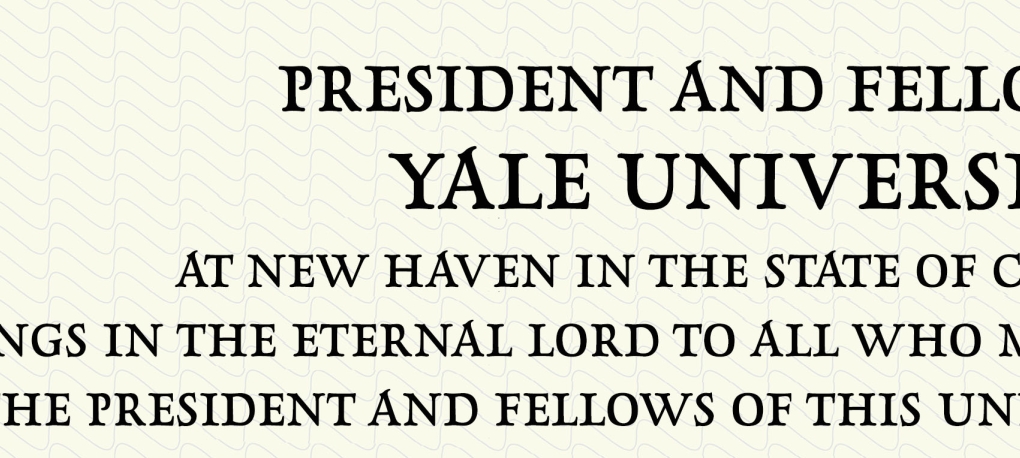
What arrives from Hopper is most often a Bene Meritum — a Distinguished Member recognition at college level rather than the University diploma itself: simple, elegant, the college’s coat carried in the front line, the recognition set large against the deliberately minimal hand of the curators beneath. We love to see the exclusive expressions and personalities these college papers carry.
Princeton University
Universitas Princetoniensis · conferring as Praeses et Curatores Universitatis Princetoniensis
Follows the regular convention with one personal habit: time and place are recorded in their own small station at the lower left. Italic and cursive alternate through the text, the graduate’s name and degree standing clear between the blocks, and a golden seal closes the sheet at the middle end.
University of Pennsylvania
Universitas Pennsylvaniensis · conferring in its own name
Admits in its own name, on the professors’ approval — ob studia a professoribus approbata ad gradum — usually with a credential code, magna cum laude where earned, and, rarely among its peers, the counter-signature of the keeper of the seal. More Pennsylvania and Wharton parchments have crossed this desk than any other institution’s.
Brown University
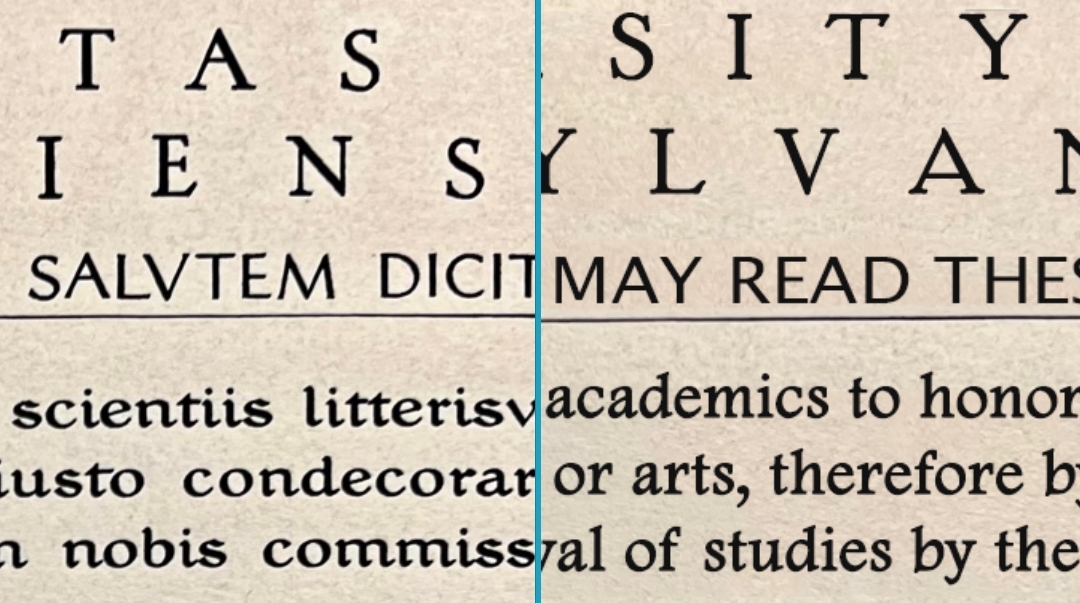
Universitas Brunensis · conferring as Universitas Brunensis Providentiae
Plain and straightforward, setting the honor of its own ground first — Providence named before all else — with measured spacings for graduate, degree, and honors, and an occasional credential code. A frequent guest at this desk.
Wellesley College
Collegium Wellesleianum · conferring as Praeses et Curatores Collegii Wellesleiani in Republica Massachusettensi
Sets the College’s own year beside the date of conferral — two calendars sharing one line — and honors the graduate’s name and degree in a distinctive hand of their own.
Bryn Mawr College
Collegium Bryn Maurense · conferring as Curatores et Concilium Academicum Collegii Bryn Maurensis in Civitate Pennsylvaniensi
Plain in approach, brutal in its heading, and alone in this catalogue in dating anno fastis gregorianis — the Gregorian calendar, declared in Latin.
Bard College
Collegium Bardianum · conferring as Curatores Collegii Bardiani
Opens sciatis nos — and that small word nos is the most commonly mistranslated word in all diploma Latin: what it performs here is not what it appears to perform, and we render what it does — the College gladly declaring the graduate one of its own ranks. The text runs narrow, pointed in the classical manner, dated ante diem against the Ides with the College’s own age beside the year; and the dateline Datis Annandale A.D. has led more than one reader — translators among them — to the wrong expansion. A cold sigil is struck into the paper itself; the signatures are wet.
University of Puerto Rico
Universitas Portoricensis · conferring as Auctoribus Professoribus Quibus Hoc Munus Commissum Est Curatores Universitatis Portoricensis
Opens in style — on the authority of the professors to whom this office is entrusted, the Trustees confer — then sets the graduate’s name and degree immediately after, the particulars following with classical point-spacing, and two seals flanking the signatures at the close. The page’s syntax rewards diligence and punishes haste: the reading order is not the printing order.
The Catholic & pontifical foundations
Here the degree ladder itself is different. The pontifical system confers by canonical grades — baccalaureate, licentiate, doctorate — in theology and canon law (S.T.B., S.T.L., S.T.D.; J.C.B., J.C.L., J.C.D.), under a register that is administrative-legal church Latin: conferral Dei et Apostolicae Sedis gratia, authority flowing through the Holy See. A translator who knows university Latin but not curial Latin renders these fluently and wrongly.
Georgetown University
Collegium Georgiopolitanum · conferring as Praeses et Professores Collegii Georgiopolitani
The oldest Catholic foundation in the United States welcomes with a gaudent badge of religious merit above — unique in this catalogue — then mixes hands and cursives below, the essential facts stepping forward through changes of font, the original seal ringed by signatures at the close. And throughout, it keeps the long ſ of older typography, which most translators fail: officials have been left reading profeſsores as “profefsors.” We read it as naturally as the eighteenth century wrote it.
Fordham University
Universitas Fordhamensis · conferring as Curatores Universitatis Fordhamensis
A large, adept engraving beneath an ornamented title — and beneath that, a lesson in one word twice: LITERAS, in omnibus praesentes literas visuris, where it means the document itself, the “present letters”; and Literis, in the ceremony’s opening hisce literis, where the same word begins the act. Dating is written out in the words of modern Latin, closing an otherwise strictly ordered sheet.
Seton Hall University
Universitas Setoniana · conferring as Regentes Universitatis Setonianae
Technical and disciplined in tongue and layout alike: no flourishes, the graduate denoted in a fine hand with the honor directly beside the name and the degree below, the sheet closing in strict order — founding date, then the year of the Lord, the sigil beside, the signatures beneath.
Saint Louis University
Universitas Sancti Ludovici · conferring in its own name
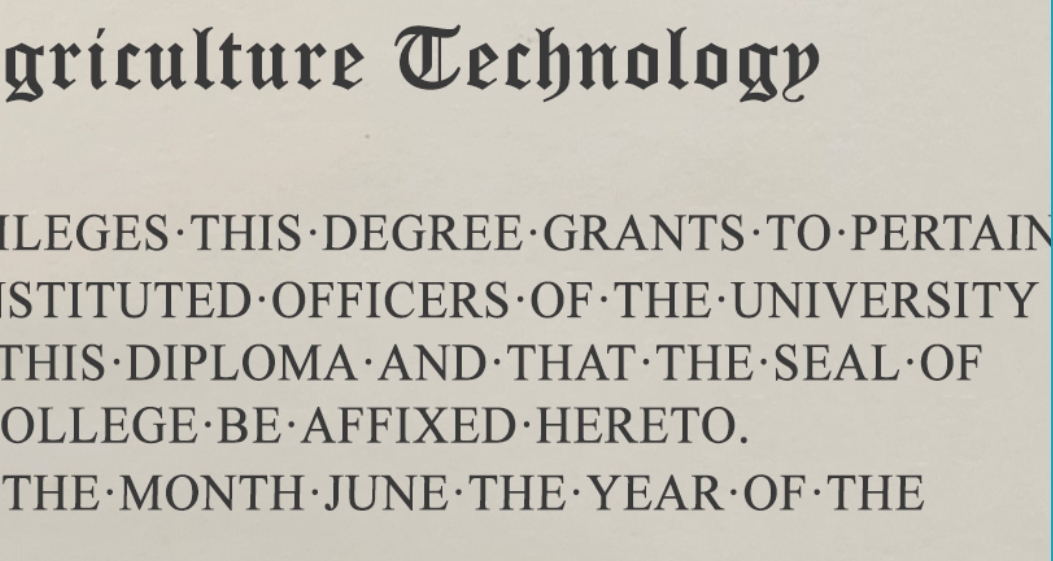
Plain, straightforward wording set in an Old English face, dated in the North American fashion — unconventionally, for a Latin sheet — the seal struck between the signatures.
Universidad del Sagrado Corazón (Santurce, San Juan)
Universitas a Sacro Corde · conferring as Praeses et Decanus Auctoritate Rite Commissa
Confers by president and dean, by authority duly committed — auctoritate rite commissa — and otherwise keeps the classic convention: classical point-spacing, an embossed seal, its accompanying safeguards beside it.
Pontificia Università Lateranense (Rome)
Pontificia Universitas Lateranensis
The Pope’s own university issues the most sophisticated instrument in this catalogue: conferred Nomini Sanctissimi Domini Nostri Francisci, by authority granted from the Holy See, the father of the university set above, the particulars — down to gender and grade — entered by hand, the arms of the Holy See beside a date convention that is, for so ancient a house, ironically modern; a handwritten diploma number; and a Greek-key bezel running the border.
Universidade Católica Portuguesa
Catholica Lusitana
Confers through the chair itself: a professor cathedratica of the Faculty of Law, and Rectrix of the same university — the seal set at the head, the wording opening with the recognition of the conferral and unrolling like a medieval leaf from a small inhabited initial.
Ateneo de Manila University
Athenaeum Manilanum · conferring as Athenaei Manilani Curatores
The Jesuit tradition carried to the Pacific, and one of the rare sheets on this desk: a bezelled title followed by a salute, a cursive succession, a golden foil struck beside classical dating, the signatures beneath.
Congregatio pro Clericis (Dicastery for the Clergy, Rome)
Not a university but a dicastery of the Roman Curia — and its instruments arrive as Italian braided with dicasterial Latin, usually in pairs: one proclaiming the name, one the process and the year of formation. The signatures are often ring-stamps, an archbishop’s, under the keys of the Holy See. We translate both instruments under the same certification as any diploma.
The Irish tradition
Dublin’s Latin is its own school.
Trinity College Dublin / University of Dublin
Collegium Sanctae et Individuae Trinitatis iuxta Dublin
One institution, two names, one diploma: Trinity is the sole college of the University of Dublin, and the parchment speaks for both. It issues Ex Aedibus Academicis — from the academic house — with the full ceremony of the Kalends: the reckoning is never what it appears to an unpractised eye, and a date shifted by days can fail to match the registrar’s record. Uniquely, the admission to the degree is recorded within the text as taken upon the committee’s date, while the issuance — usually the same day — stands alone at the lower left.
National University of Ireland
Universitas Nationalis Hiberniae
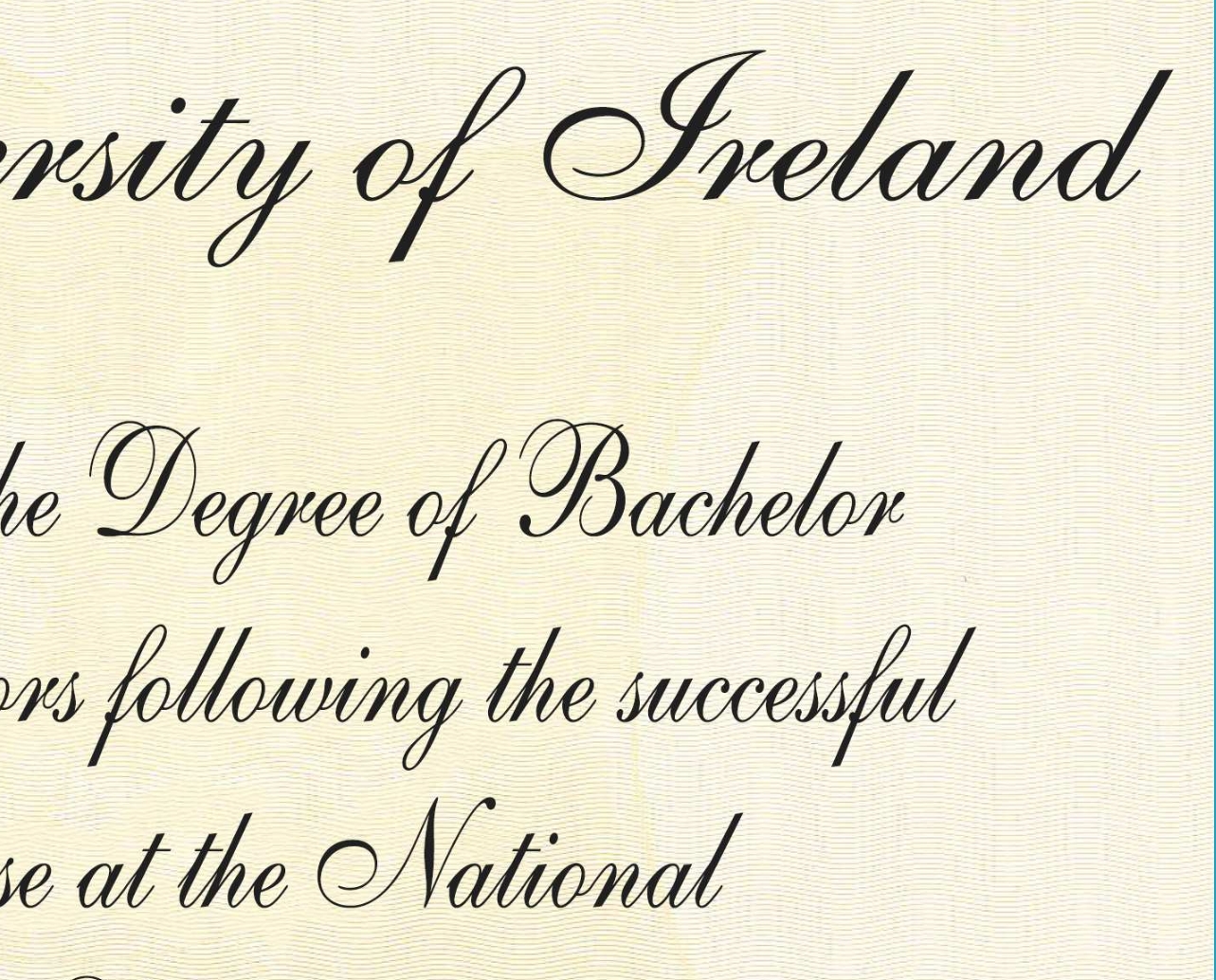
Faces its leaf with a double coat of arms — the University’s own beside the faculty’s, each named in the text below — heraldry that has been mistaken for words by untrained eyes. It closes with dating in Roman numerals and its distinctive red seal beside the presidential signature. Among the most frequent Irish visitors to this desk.
The British & Mediterranean
University of Glasgow
Universitas Glasguensis · opening Noueritis omnes Almam Universitatem Glasguensem
Know, all — the alma universitas announces itself in the most official register on this page: lean, ordered wording on a spacious leaf, a cold stamp, a diploma number standing usually at the lower left. Its English inclusion describes the diploma’s character rather than translating it — the translation remains ours to make — and submissions usually pair it with a Transcript of Studies. Dated anno salutis: the year of salvation, an ordinary year in liturgical dress.
University of Malta
Universitas Melitensis · conferring as Universitatis Rector Melitensis
A grown design: an Old English face for the title, a paragraph of authenticity carrying a short history of the house, then the ceremony turning to address the graduate directly — With you, therefore… — the degree given ipse, by the authority itself. Dated by the Kalends, counting backwards and inclusively: the number on the parchment is not the day of the month. Of all the sheets in this catalogue, Malta’s is the one where syntax itself becomes the display.
The continental universities
Continental Latin diplomas descend from the medieval universities directly, and their habits are older than the American ones they inspired.
Charles University
Universitas Carolina / Universitas Carolina Pragensis
Two houses in one, and the oldest tradition on this page (founded 1348). The two forms issue distinct instruments, both opening under the old auspice Q.B.F.F.F.Q.S. and Summis Auspiciis Rei Publicae Bohemicae. The Prague form — rector and faculty dean conferring together — is the more ordained: every element in its own face, the variable particulars in a written hand, the graduate’s date of birth recorded, the date and diploma number closing the very last line; and it attributes merit rather than conferring title — a distinction the translation must keep. The Carolina form adds the pertaining law, its year and number. Both bear the seal as a cold stamp.
Politecnico di Milano — and the polytechnics
Italy and Greece seat a polytechnic in nearly every major city, and they write the modern successor of the Latin sheet: opening Si dichiara che — a declaration — then the head’s observations, the legal particulars, the grades. Where Latin appears, it lives in the coinages: engineering and the applied sciences Latinized by institutions, not by tradition. The results range from elegant to broken, and translating them means rendering what the institution meant to confer.
The Canadian universities
McGill University
conferring as Nos Gubernatores Rector Socii
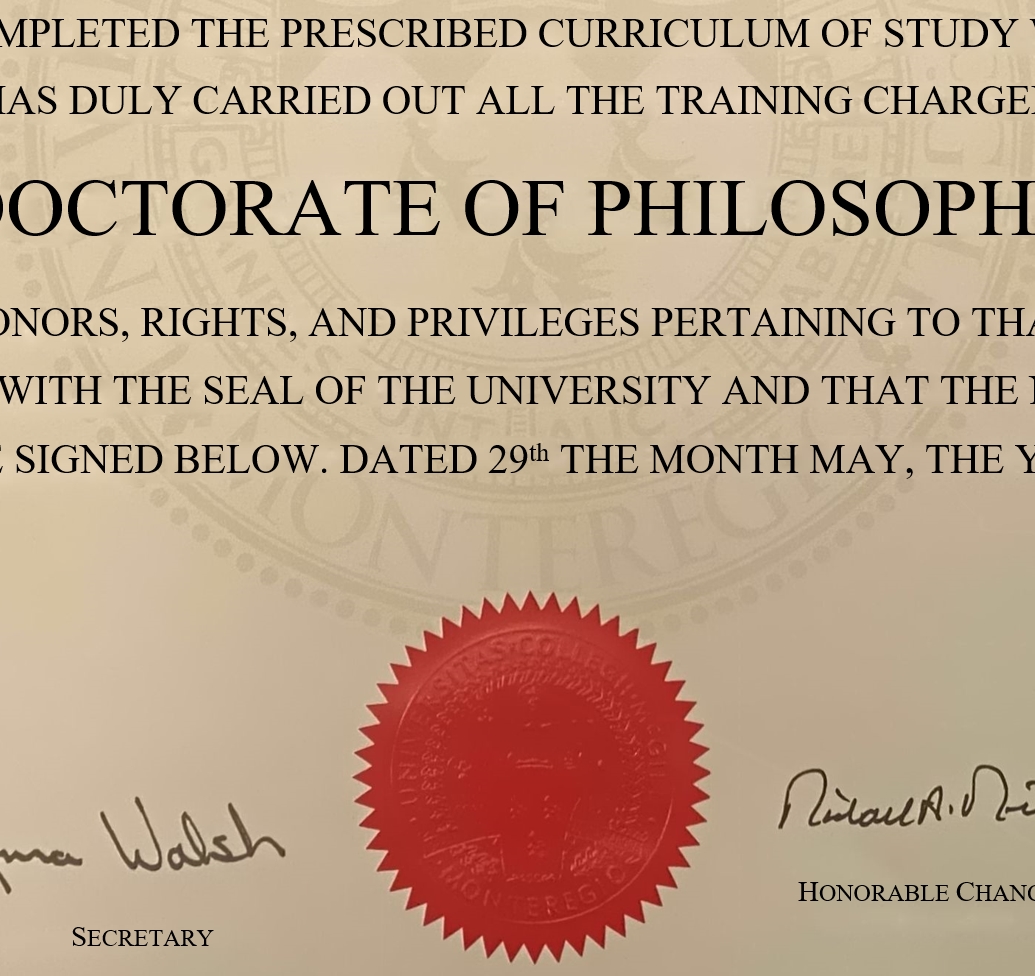
We, the Governors, the Principal, the Fellows — an ordered page of paragraphed explanations, the graduate and the degree honored in large type, the conferral reasoned almost as cause and effect. Common dating followed by anno Domini; seal and signatures at the close — and the same seal embossed again as a watermark across the body of the sheet.
University of Manitoba
Universitas Manitobensis · conferring as Commendante Senatu Admisit
Admitted on the Senate’s commendation — one of the rare and, frankly, best-loved sheets on this desk: historical in bearing, elegant and uncrowded, right on the spot. Its chirographic sigil is perambulated by the signatures of master, chancellor, president, prefectal governor, and dean, and it dates in plain Roman numerals with — characteristically — no year-word at all.
Bishop’s University (Lennoxville, Québec)
Universitas Episcopi de Lennoxville Canadensis
The only diploma in this catalogue that leads with the French form of its name before the Latin, exalting its “ingenious young” graduate to the degree; the signatures close, the year stands without a year-word at the foot, the seal at the right of the leaf. And its house idiom remains so much its own that omnibus quorum intersit — to all whom it may concern — alone opens onto a dozen defensible renderings. Choosing among them is judgment, not lookup; without the philological grounding, a translator picks one and hopes.
Withdrawn from the catalogue: Howard University and the University of Zurich — neither has yet crossed this desk, and this page states only what has. Each gains its entry the day its first parchment arrives.
Peculiarities met at this desk
Not every Latin diploma is sound Latin. Among the documents that have crossed this desk: a Legum Magistratus — which means a magistracy, not a master, the standard being Legum Magister; a Bachelor of Science in Mechanical Engineering erroneously rendered as Curatores Mechanici, syntactically incoherent, since curatores are managers and no reading yields engineering; a Natural Resource Management degree whose Latin collapses case, gender, and syntax past the point of literal sense; medicine-and-surgery degrees split into two baccalaureates where tradition compounds them into one; and honorary degrees framed in a genitive no register contains.
The translator’s task with such a diploma is fixed: determine what the institution meant to award, render that faithfully in English, and neither reproduce the error nor silently correct the Latin. The holder’s credential is what the institution intended to confer — not what its engraver managed to set.
The full catalogue of degree titles, standard and otherwise, is in our reference table.
What the translation must get right
Four things decide whether a Latin diploma translation survives scrutiny: the degree title, which does not map one-to-one onto modern equivalents; the dating, where the ceremonial calendar defeats non-specialists; the institutional apparatus — datelines, signatory titles, and heraldry that is not text; and the conferral formulae, which are house-specific and archaizing. The full anatomy of each is on our Latin translation page.
Frequently asked questions
Will an employer, university, or licensing board accept your translation of my Latin diploma?
Yes — that is precisely what a certified translation is for. Institutions phrase the requirement differently — certified translation, official translation, translation with a statement of accuracy; USCIS, universities, and credential evaluators print these very words in their requirements — but they name the same deliverable: an exact English rendering accompanied by a signed statement of its completeness and accuracy. Every EnLatin diploma translation includes that statement, signed by the senior philologist who certified the work, the EnLatin stamp, and a verifiable order code the receiving side can check, at no added charge.
How fast can it be done?
Typically within a few hours, up to just a day, depending on complexity and scan clarity. Same-day delivery is available at checkout.
What does it cost?
Currently at €27.00 a page. A diploma is usually a single page. University-attached English annex pages — verification notes, leaflets — are not counted and not charged.
Do you also translate the transcript that came with my diploma?
Yes — either together with your diploma translation, or as a separate document according to your order. Transcripts are usually issued in English by the same universities that issue Latin diplomas; where yours needs certified translation or certification of the pairing, our diploma and transcript service covers it, priced per transcript page exactly as the diploma is priced per page. (Distinct from the free annex pages: a transcript is its own document.)
My university is not on this page. Can you still translate my diploma?
Yes. The catalogue records the houses whose parchments we have already rendered — the common ones, not the limits of the desk. Yours will be read with the same care whatever its origin; the traditions above cover the ground.
My diploma’s Latin seems to contain an error. What happens to it in translation?
It happens more often than universities would like. We determine what the institution meant to award, render that faithfully, and neither reproduce the error nor silently rewrite the Latin — see the peculiarities note above.
My diploma has an apostille attached. Do you translate that too?
Yes — the apostille is translated with the document it certifies. We translate apostilled diplomas; we do not issue apostilles, which come from the designated authority in the issuing country.
The date your translation shows differs from what I expected.
Then the diploma is almost certainly dated by the ceremonial calendar — Kalends reckoning — and what you expected was a misreading of it. The date question is answered fully on the Latin page. If a genuine discrepancy remains after that, it lies between you and your registrar — and if their correction changes the document, we amend the translation free of charge.
My diploma is digital — a CeDiploma, or a PDF with a verification link. Can you translate it?
Yes — and nothing about it changes our work. Certified electronic diplomas (CeDiploma, verified by CeDiD under CeCredential Trust) and university-issued PDFs are translated exactly as parchment is, with the credential identifiers and verification notes carried into the translation so the receiving side can still verify the original directly. Our translation range is timeless. We live in time — diplomas don’t.
My diploma is not in Latin. Can I still submit it?
Yes. EnLatin provides official and certified translation of diplomas and transcripts in Greek, Italian, German, French, Spanish, Portuguese, Russian, and Turkish alongside Latin — a laurea, an απολυτήριο, a YÖK diploması all receive the same meticulous attention from the same philologists. Our diploma and transcript service is their home.
Is my Harvard diploma in Latin?
Yes — Harvard has conferred in Latin since the seventeenth century, and the diplomas that reach this desk open with a great inhabited initial Q, for Quoniam. One thing surprises people: the English-language record your registrar holds and the Latin parchment in your hand are two different documents. The registrar's copy is not a translation of the parchment, and a receiving institution asking for “the diploma” usually means the one you were handed at Commencement.
Is my Yale diploma in Latin?
Yes. Yale confers as Praeses et Socii Universitatis Yalensis — the President and Fellows — in one of the most orderly Latin sheets in the American tradition, with distinction recorded where earned. Note that Yale's residential colleges issue their own documents separately: a recognition from Grace Hopper College, for instance, is a college-level paper rather than the University diploma, and the two are translated as what they are.
Does Princeton issue diplomas in Latin?
Yes, conferred by Praeses et Curatores Universitatis Princetoniensis. Princeton's habit worth knowing is where it puts the date and place — in their own small station at the lower left, rather than in the body of the text. A translation that overlooks that corner has left out the conferral date.
Is my University of Pennsylvania diploma in Latin?
Yes — and Penn confers in its own name, on the professors' approval, ob studia a professoribus approbata ad gradum. Penn sheets usually carry a credential code, magna cum laude where earned, and, unusually among its peers, the counter-signature of the keeper of the seal. More Pennsylvania and Wharton parchments have crossed this desk than any other institution's.
What language is a Trinity College Dublin diploma in?
Latin — and Trinity is also the University of Dublin, one institution under two names, with the parchment speaking for both. It is the single most common source of date confusion we see: Trinity dates by the Kalends, counting backwards and inclusively, so the number printed on the parchment is not the day of the month. If your diploma date has never matched your records, this is almost always why.
Is my National University of Ireland diploma in Latin?
Yes. NUI presents its leaf with a double coat of arms — the University's own beside the faculty's — and closes with Roman-numeral dating and a distinctive red seal. The heraldry is the trap: a charge within a shield is a device, not a word, and untrained readers have rendered them as text.
My diploma is from a pontifical or Catholic university. Is that different?
Yes, in a way that matters. Pontifical faculties confer by canonical grade rather than by the ordinary degree ladder — baccalaureate, licentiate, doctorate in theology or canon law (S.T.B., S.T.L., S.T.D.; J.C.B., J.C.L., J.C.D.) — under authority flowing from the Holy See. The register is curial Latin, not university Latin, and a translator fluent in one is not thereby fluent in the other. Georgetown, Fordham, Seton Hall, Saint Louis, the Lateran, Católica Portuguesa and Ateneo de Manila are all in the catalogue above.
Why is my name spelled differently on my Latin diploma?
Because it has been Latinized — Ioannes for John, Maria for Mary, or a surname given a Latin ending to fit the grammar of the sentence conferring the degree. This is normal and it is not an error. Our translations render your name as it appears on your passport, with the Latinized form noted, so the receiving officer can match the parchment to your identity documents without having to guess.
My diploma is in Latin but my transcript is in English. Do I need both translated?
Usually only the diploma. Universities that confer in Latin almost always issue transcripts in English, and a document already in English needs no translation — we do not charge for pages that do not require work. Send both, and we will tell you which actually needs translating before you order.
Ready when your diploma is.
Not sure what you are holding? Send us a photograph and we will tell you what it says, what it needs, and what it costs — before you order. salve@enlatin.net